ZGCTA Activities
ZGCTA Secretary-General Delivers Keynote Speech and Attends Unveiling Ceremony at the BRICS Forum on Partnership on New Industrial Revolution 2026
Date:2026-06-03 12:21
On May 27 and 28, the BRICS Forum on Partnership on New Industrial Revolution 2026 was successfully held in Xiamen, Fujian. Li Junkai, Secretary-General of the ZGC Global High-Level Think Tank Alliance (ZGCTA) and Director of the Center for International and Regional Cooperation at the Beijing Academy of Science and Technology, was invited to attend the forum's related event—the Sino-Russian International Cooperation Seminar on Digital Fields and the release of the “2025 White Paper on Russia’s Digital Economy (Chinese Edition)”. She delivered a keynote speech and participated in the unveiling ceremony, sharing think tank perspectives on China-Russia digital cooperation pathways and advancing deeper and more solid China-Russia digital ecosystem synergy under the BRICS framework.
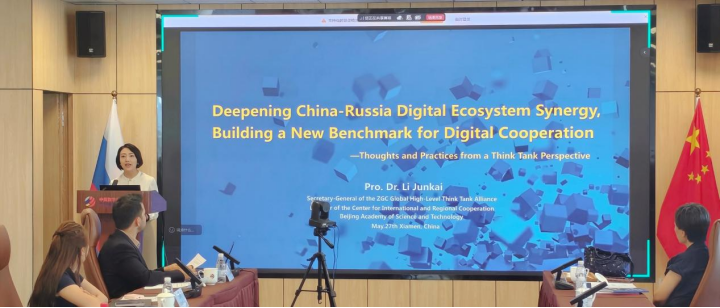
Li Junkai Delivering Keynote Speech
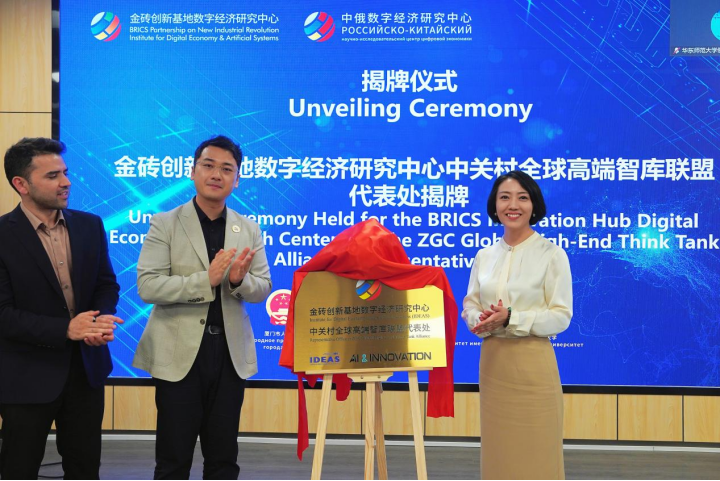
Unveiling Ceremony
This symposium was co-hosted by the ZGCTA Digital Economy Innovation Center (Xiamen), the Institute for Digital Economy and Artificial Systems BRICS-PartNIR, the Sino-Russian Joint Laboratory for Intelligent Computing in Digital Economy, and the New Eurasian Land-Sea Transport Corridor Research Institute. Representatives from government departments, research institutions, universities and enterprises in China and Russia conducted in-depth exchanges on topics including China-Russia digital policy coordination, technological innovation, industrial linkage and think tank empowerment.
Li Junkai delivered her keynote speech titled "Deepening China-Russia Digital Ecosystem Synergy, Building a New Benchmark for Digital Cooperation—Thoughts and Practices from a Think Tank Perspective". She noted that this year marks the 30th anniversary of the establishment of the China-Russia Strategic Partnership of Coordination, and the digital economy has become an important direction for upgrading bilateral cooperation. The report systematically reviewed the development achievements of China and Russia in policy coordination, technology implementation, industrial linkage and think tank empowerment. Combining ZGCTA's cooperation practices with think tanks in Russia and other BRICS countries, she elaborated on the bridging role of high-level think tanks in connecting innovation resources and linking policy research with industrial implementation. For future cooperation, Li Junkai proposed four implementation paths from a think tank perspective: build a "think tank-led" collaborative decision-making mechanism, focus on full-chain ecosystem co-construction in key areas, strengthen the "talent-supported" collaborative training system, and build a "pragmatic and efficient" industrial docking platform, providing intellectual support for long-term and stable China-Russia digital cooperation.
During the event, the ZGCTA Representative Office of the Institute for Digital Economy and Artificial Systems was officially inaugurated. As an important layout for ZGCTA to serve BRICS cooperation and expand regional innovation networks, the representative office will be based in Beijing and radiate across BRICS countries. It will promote the landing of think tank resources, technological achievements and talent projects at the BRICS Innovation Hub, supporting the construction of the Beijing (Beijing-Tianjin-Hebei) International Science and Technology Innovation Center and the coordinated development of the digital economy among BRICS countries.
This participation has further consolidated ZGCTA's platform advantages in science and technology think tank cooperation between China, Russia and other BRICS countries, and expanded practical cooperation channels in the digital economy. Looking ahead, ZGCTA will continue to leverage its role as a multilateral science and technology think tank exchange platform, deepen linkages with think tanks in Russia, BRICS countries and Belt and Road partner countries, and contribute more think tank strength to advancing the construction of the BRICS Partnership on New Industrial Revolution and promoting open international scientific and technological cooperation.
Key personnel from the ZGCTA Secretariat also attended the event and participated in the roundtable discussion.
(Text by the ZGCTA Secretariat Office; Photos by the Institute for Digital Economy and Artificial Systems )